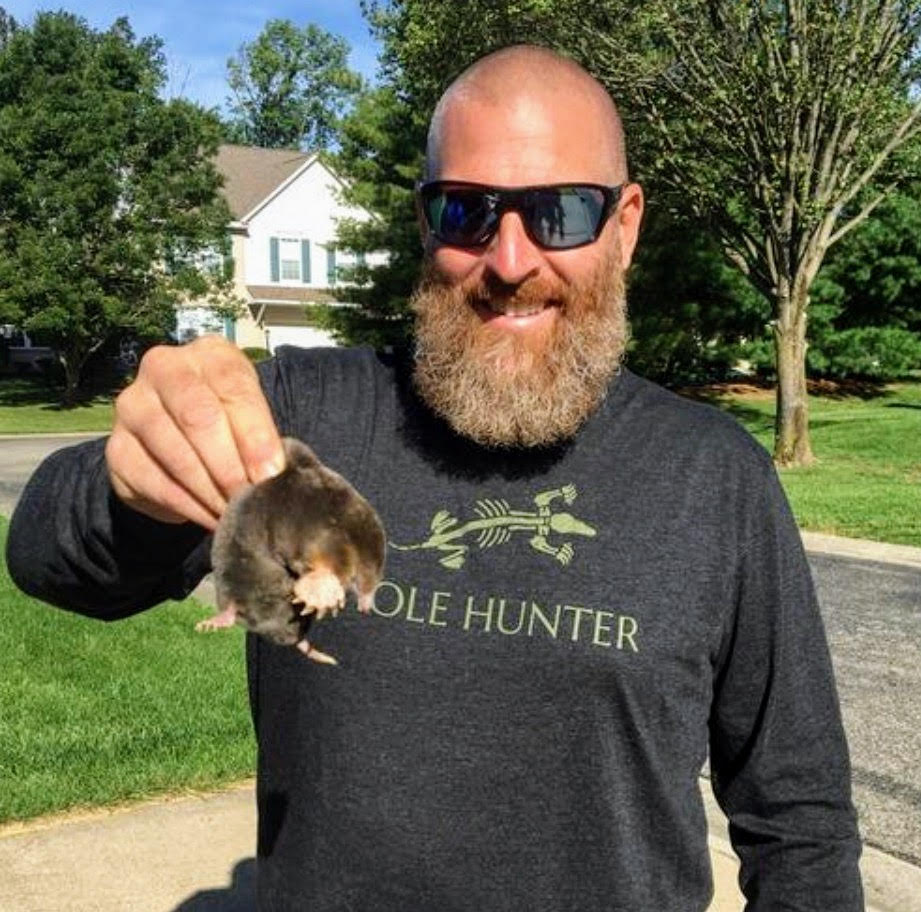
Yes, moles have two eyes. No, they are not blind. Mole eyes detect light and dark, and that’s about it.
If you’ve found a fresh mole hill or a raised ridge across your Cincinnati-area lawn, here’s what the animal responsible can and can’t actually see.
Eastern Mole Eyes: What the Anatomy Shows
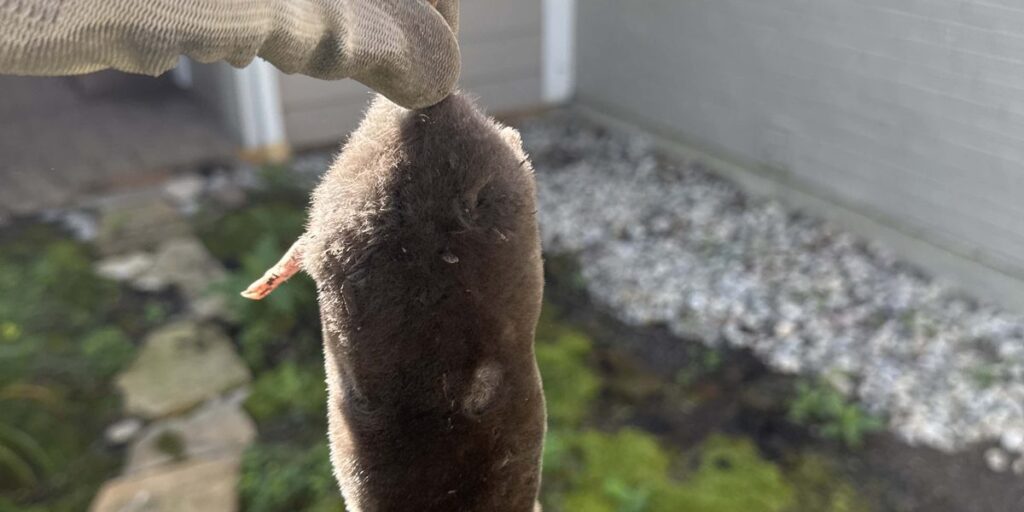
The eastern mole (Scalopus aquaticus) causes most mole problems in Greater Cincinnati, from Loveland to Blue Ash to Anderson Township. It’s one of seven species of true mole found across North America.
Each eye measures roughly 1 mm across, about the size of a pinhead. It sits recessed in the head, sealed under a thin layer of skin that works like a permanently closed eyelid. Everything else about the animal is built for digging, from the compact, cylindrical body to the broad front paws, and none of it is given over to sight.
The retina works. So does the optic nerve, the wire that carries signals from the eye to the brain. The failure is in the lens. It never finishes forming, so nothing focuses. Where a human eye resolves color, edges, and depth, a mole’s eye registers the difference between darkness and light, never what caused the change.
What this means for your yard: nothing you can see from your porch (a mound, someone crossing the grass) means anything to a mole as a sight. It may well feel you. It will never see you.
How Many Eyes Does a Mole Have? And Are Moles Blind?
Two eyes, always, and no. The term you’ll see for the eastern mole is “technically blind,” which is shorthand for eyes that work without producing anything resembling vision. People assume moles are eyeless because the eyes are so well hidden, not because they are. Part the fur on the side of a captured mole’s head, and there’s a tiny black dot underneath, easy to miss even when you know where to look.
Why Do Moles Still Have Eyes?
A retina takes energy to maintain, and an animal that spends its whole life underground looks like a strong candidate to lose its eyes entirely. Evolution did strip the mole’s vision down close to nothing. What it left behind serves one job: sensing a breach.
Daylight flooding a tunnel means the run is open to the surface. Sometimes that’s the mole surfacing under its own steam. Often it’s a cave-in or a predator digging down from above, and the mole has no way to tell the difference, so it treats light as a threat and retreats. A mole caught above ground in an Ohio backyard is exposed to hawks, owls, foxes, coyotes, and neighborhood dogs, and any of them will take the opportunity.
Research on the Iberian mole, published in BMC Biology in 2008, traced where that breaks down. Eye development starts out normally and then diverges: the lens begins to form and never completes the process, while the retina and optic nerve develop close to normally.
How Moles Navigate Without Sight
Everything happens at the snout. Among North America’s small mammals, few are as narrowly built for tunneling as the eastern mole, and the snout is where that specialization concentrates. It’s covered in sensory bumps called Eimer’s organs. These touch receptors read soil particles and vibration, and they do the work eyes would otherwise do. A mole feels an earthworm shifting nearby before it ever makes contact.
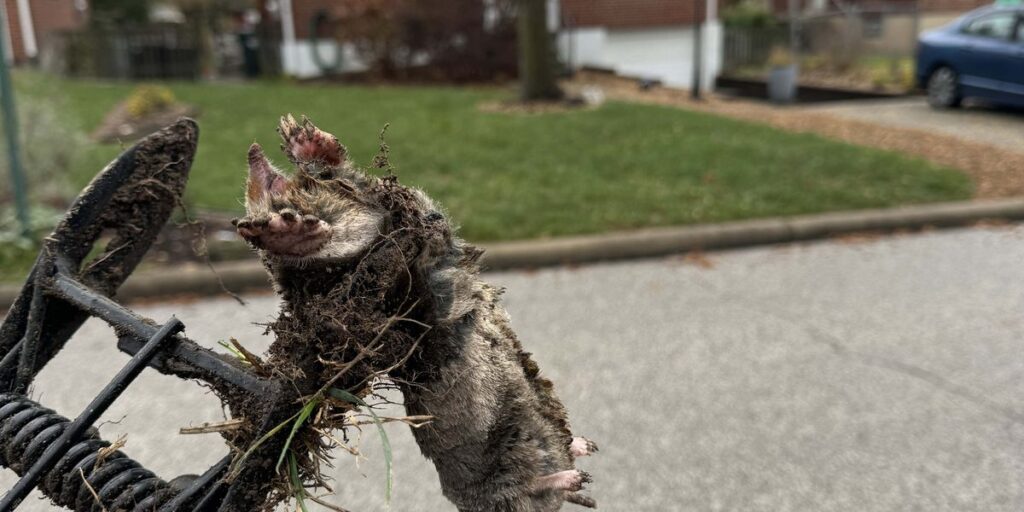
Smell adds a second layer. Separate nostrils let a mole pick up scent on each side and compare the two. In feeding trials, researchers at Vanderbilt University studying how moles smell in stereo found eastern moles locating an earthworm in about five seconds.
Touch and scent together are how a mole finds food and builds a working map of mole tunnels it has never seen. When a worm falls into an active run, none of what happens next depends on sight. Studies of the European mole describe it pulling a worm through its paws to squeeze the soil out of the worm’s gut before eating, all of it by feel.
Are Moles Deaf, Too?
No. Eastern moles have no visible external ears, only small openings hidden under fur, so people tend to assume hearing went the way of sight.
It didn’t. Moles pick up low-frequency vibration, which is why a lawnmower running or footsteps crossing the yard will register even though nothing about either is visible to them.
Mole Species: Star-Nosed, Shrew Moles, and Animals That Borrow the Name
Most mole species share the eastern mole’s basic setup, with one notable variation.
The star-nosed mole, found across northeastern North America, ends its snout in a ring of fleshy, mobile feelers packed with Eimer’s organs. Its sense of touch is sharper than that of other moles. Its eyesight is not. The two belong to the same family but sit on different branches of it, and the star-nosed is adapted to wetter ground.
Two other names cause confusion. Golden moles live in sub-Saharan Africa, and marsupial moles are Australian pouched mammals; neither is a true mole or closely related to one. The American shrew mole is a genuine member of the mole family, but it lives only in the Pacific Northwest, so it’s not the animal in an Ohio lawn either.
What an Eastern Mole’s Eye Looks Like Up Close
I’m Jeff Cooper, owner of The Mole Hunter. I’ve been catching moles since 1995, when I learned to do it by hand while maintaining the grounds at an Ohio country club, and I’ve been pulling them live out of traps ever since.
These days I wear a glove and work slowly — a live mole in the hand bites, and the teeth are sharper than people expect. Finding the eye means parting the fur along the side of the head deliberately, every single time. It shows up as one dark point, no wider than a pinhead, set into skin that would otherwise pass for solid fur.
What that tells you about the animal in your lawn is simple. It never saw the trap, and it was never going to. Everything it knew about that tunnel came through its snout.
Why This Matters for Your Lawn
A mole navigating by touch responds to what it feels through its snout and paws. Reflective spinners and similar visual deterrents have nothing to work on, because there’s no functional eyesight there to fool.
That same sensitivity puts the weight on trap placement rather than the trap you buy. Open a tunnel to set one and the mole feels the disturbed soil immediately, then plugs the opening with dirt before the trap gets a chance.
Our soil makes that harder here than it would be in a lot of places. Southwestern Ohio sits on Cincinnati silt loam, deep and crumbly and heavy with organic matter, which is close to ideal ground for earthworms and therefore close to ideal for the animal hunting them. Beneath it lies a fragipan, a dense compacted layer that traps spring rain high in the soil profile. The worms move up toward the moisture, the moles follow, and the fresh surface ridges you’re looking at in April are the result. More on why Ohio soil produces so many moles.
Loose, damp soil also transmits vibration better than dry, packed ground, so a mole in Cincinnati silt loam feels you working the run sooner than one in heavy clay would. Extension figures put a mole’s daily intake at 70 to 80 percent of its body weight in worms and grubs, which is why a yard with good worm numbers doesn’t stay vacant for long after one mole is removed.
Can a Mole See a Trap?
No. It only feels one.
Common Myths About Mole Vision
Blind means no vision at all. Eyeless means no eyes at all. Neither describes a mole, whose eyes are real, severely limited, and easy to overlook.
Moles aren’t nocturnal either. Extension sources describe them working in shifts around the clock, roughly four hours active and four hours resting, regardless of what time it is above ground. Surface activity patterns follow that internal clock, not sunrise or sunset.
Baby Moles: Born With Their Eyes Closed
Eastern moles mate between January and April, and litters of three to five pups arrive anywhere from late February through early June. They’re born hairless, with eyes sealed shut. That spread is worth knowing if you’re fighting moles in a Cincinnati lawn: a yard that looked clear in March can show fresh ridges in May, and it isn’t always the same animal coming back.
Over the first few weeks fur comes in and the eyes open. Vision develops only to the same limited light-detection level adult moles have, and in nature it never improves past that point.
Moles vs. Voles vs. Shrews
Not everything tunneling under your lawn is a mole. Voles are rodents with normal, functional eyes and small, partially hidden ears. They feed on plant roots and chew shallow surface runways through the grass, rather than pushing up the raised ridges and mole hills a digging mole leaves behind. Shrews have small but working eyes, hunt insects at the surface, and often travel through runways other animals dug.
Purdue Extension draws the distinction along diet and tunnel structure. Moles are insect eaters that run tunnels below the surface. Voles are rodents that feed above it.
If you’re not sure which animal you’re dealing with, identifying the species first will save you from treating the wrong problem.
A Word on Safety
A mole can’t see you coming, but it can feel you, and being grabbed triggers a fast defensive bite. Eastern moles have sharp teeth built for insects and they use them. Leave the handling to someone who does it for a living. If you find an injured mole and want it looked at rather than removed, a licensed wildlife rehabilitation center is the right call, not a shoebox in the garage.
Mole Senses at a Glance
| Sense | What It Detects | What It Means for Your Yard |
|---|---|---|
|
👁️ Sight
|
Light versus dark only | Spinners and other visual deterrents are wasted; light in an open run triggers a retreat |
|
🖐️ Touch (Eimer’s organs)
|
Soil particles, pressure and texture | Traps need undisturbed tunnel walls or the mole digs around them |
|
👃 Smell
|
Directional scent gradients | Surface repellents seldom reach deep enough to cover the scent of real prey |
|
👂 Hearing
|
Low-frequency vibration | Footsteps and lawnmowers register clearly despite no visible ears |
Get a Free Mole Inspection
An eastern mole’s world runs on touch and scent, plus the occasional flash of light it can’t do anything with except back away from. A DIY trap can sit empty for a week for the same reason, while the ridges keep spreading.
"We used the service and they solved our mole problem. Brad was our technician and he was awesome friendly, professional and very knowledgeable!"
If you've got active mole damage anywhere in Greater Cincinnati, we'll walk the yard and show you exactly where the active runs are before we set anything. Request a free inspection or call (513) 613-2289.