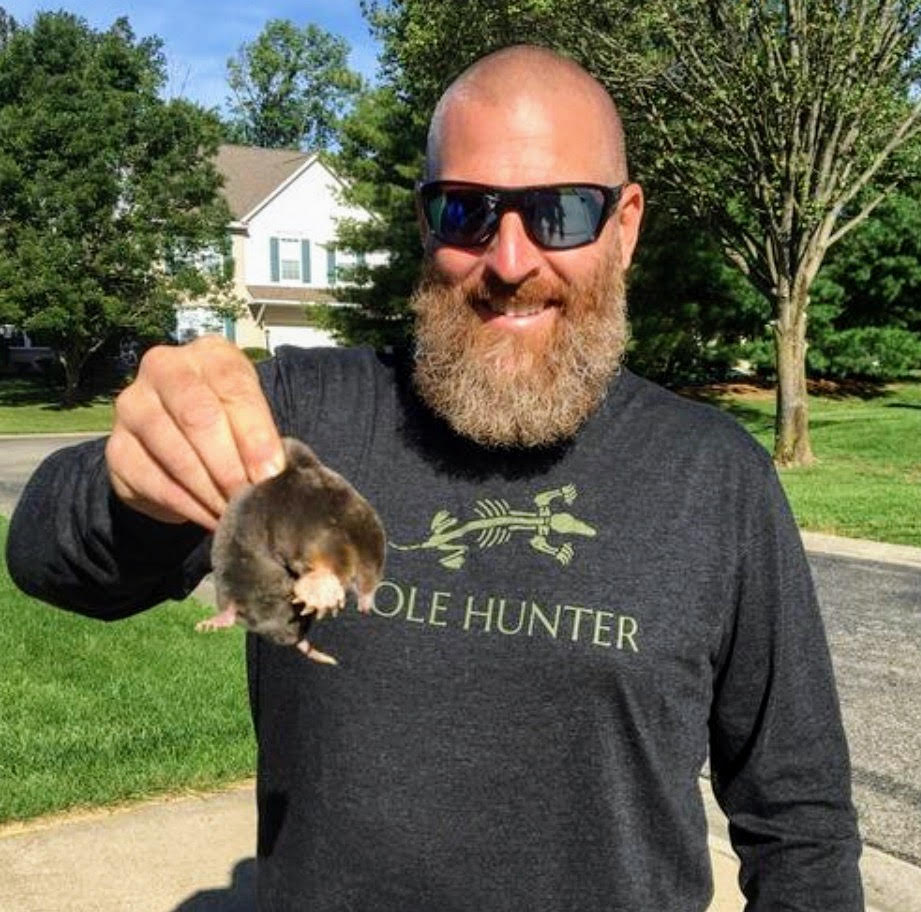
If you’ve got fresh ridges across your lawn in Loveland, Mason, Milford, or Lebanon, you’ve probably already looked into castor oil and moles. If there’s a bag of castor oil granules for moles in your garage, here’s what it can and can’t do.
Castor oil can push a mole off a treated patch for a few weeks. It doesn’t remove the mole, and the ridges often come back after a heavy rain. The research backs that up, and knowing why matters more than the price on the bag.
Why People Think Castor Oil Repels Moles
A lot of pages claim moles barely use their sense of smell. By that logic, a strong-smelling oil shouldn’t bother them. That’s backwards. A 2013 Vanderbilt study, published in Nature Communications, found that eastern moles smell in stereo, comparing input from each nostril to find a worm in under five seconds. Blocking one nostril made the mole veer off course. Crossing tubes between both nostrils was more telling: the mole searched back and forth and couldn’t find the food at all. A strong, unfamiliar odor can throw off the directional smell cues a mole relies on to navigate. That’s why the idea isn’t nonsense, and why castor oil shows up on so many lists of natural mole repellent options homeowners try first.
Does Castor Oil Kill Moles?
No, it doesn’t kill anything. It’s a repellent: moles are sensitive to its odor, and it pushes them off the treated patch for a while. You’ll also see claims that castor oil makes moles sick. No research supports that. So does castor oil get rid of moles? Not on its own.
What the Research Found
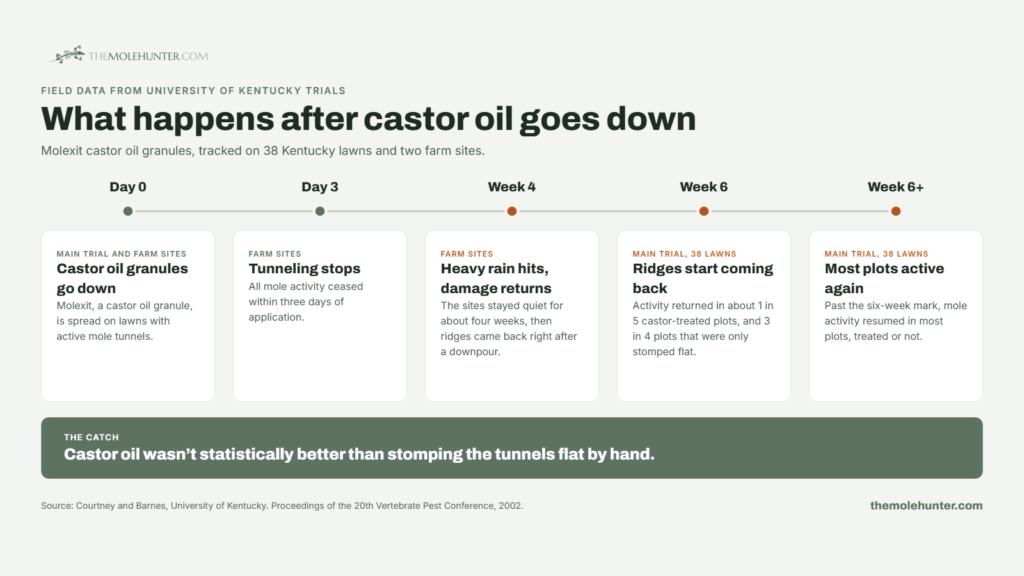
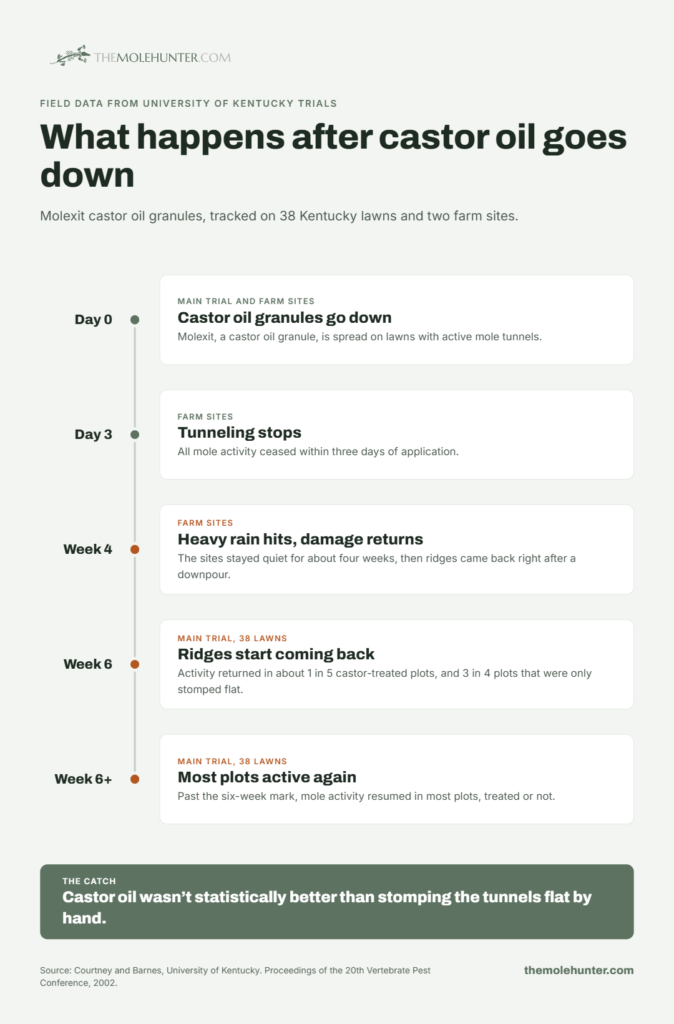
The most useful study came from the University of Kentucky, where researchers Courtney and Barnes tested a castor oil granule called Molexit, using Fuller’s earth as its carrier, and published their results in 2002. An early five-lawn pilot showed no difference between plots; the researchers blamed a drought and a manufacturing defect. The bigger trial, across 38 lawns in central and western Kentucky, stopped tunneling in 80 percent of the treated plots. The researchers applied the treatments from February into early spring, when mole activity runs high.
But the granules weren’t statistically better than stomping the tunnels flat by hand, a comparison almost nobody else mentions. The Kentucky researchers point to an earlier 1997 Michigan study on a different castor product that showed some effect, though it lacked scientific rigor. Ohio State Extension is harsher, listing castor oil among home remedies with little value in controlling moles.
How Long Does the Initial Castor Oil Treatment Last?
In the main Kentucky trial, the initial treatment kept most treated lawns quiet for about six weeks. At the six-week mark, activity had returned in about one in five treated plots but three in four stomped plots. Past that point, activity came back in most plots either way. On farm sites, activity stopped within three days and stayed gone for four weeks, until a heavy rain hit and the damage came back. That trial tested one commercial granule. Its results don’t carry over to a homemade spray. Nebraska Extension’s guide reaches a similar conclusion, rating castor products as showing only minor effectiveness.
Will Moles Come Back After Castor Oil?
Usually, once it rains. A lot of water, from rain or irrigation, leaches castor oil out of the ground quickly, and a heavy rain does it all at once. That’s what happened on the Kentucky farm sites, where the damage came back right after a downpour. Mole digging peaks in May and June, and in May 2026 Cincinnati logged 6.35 inches of rain, 1.68 above normal, according to NWS Wilmington’s May 2026 summary.
Once the oil is gone, nothing masks the smell, and a mole that never left the neighborhood goes right back to work.
We hear this a lot: ridges quiet down for a couple of weeks, then fresh ones appear once the next storm rolls through.
Is Castor Oil Safe for My Dog and My Lawn?
As long as you follow the label, yes. Castor oil is on the EPA’s minimum risk pesticide list under FIFRA’s 25(b) exemption, so the ingredient is considered low risk. EPA doesn’t review these products before they’re sold, though, so the claims on the bag haven’t been checked. Follow the label around pets, children, and the lawn itself.
The real risk is the castor bean plant itself. Its seeds contain ricin, and the ASPCA lists the plant as toxic to dogs, cats, and horses. Don’t plant it as a living barrier. The processed oil has had the ricin removed; the raw seeds have not.
Do Castor Oil and Dish Soap Work?
The mix can repel a mole for a while, same as the bagged products, but nobody has tested the homemade version on its own, so there’s no data on how long it lasts. The dish soap works as a surfactant, turning the combination of oil and water into an emulsion that goes through a hose-end sprayer, the kind that screws onto a garden hose. Liquid concentrates work the same way, and granules carry the oil on a clay base that’s spread and watered in. Nebraska Extension notes that castor products have to be watered thoroughly into the lawn to work at all. They also need complete coverage: moles tunnel under a strip around the edge, and a gallon of diluted spray covers only about 300 square feet.
Is It Even a Mole in Your Yard?
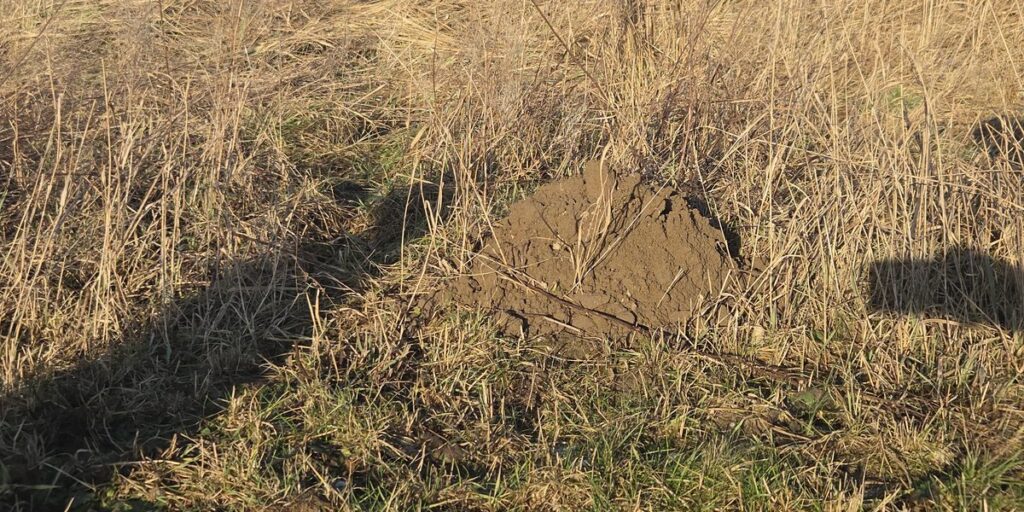
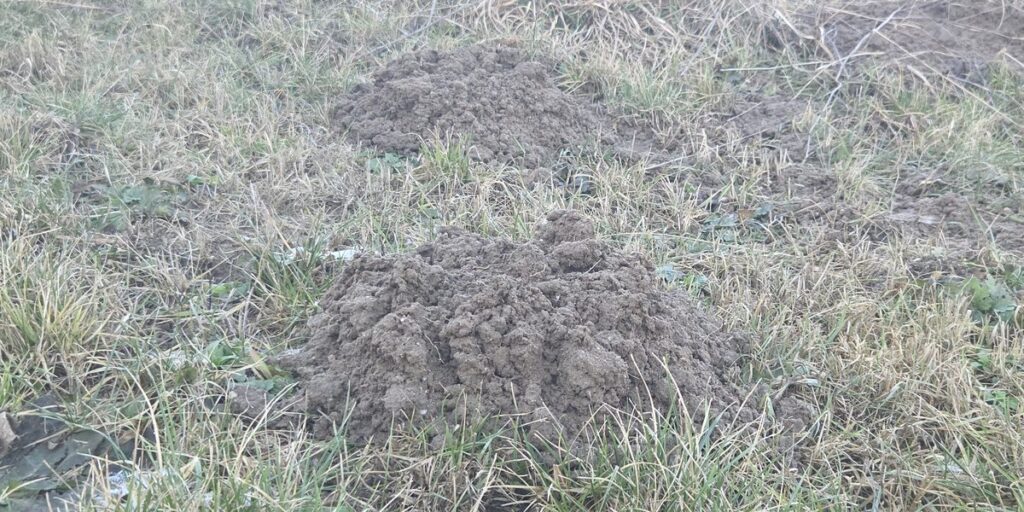
Confirm what’s digging up your lawn before you waste a weekend trying to protect it. In the Kentucky study, for example, only 5 of the first 48 callers actually had mole damage; in a second round, it was 38 of 78. The rest had voles or chipmunks, and some had no visible damage at all.
Check off what you’re seeing below. 👇
🔍 Your Diagnosis
Select the signs you’re seeing above to see what might be causing them.
Or call (513) 613-2289
Still not sure? Fresh mole damage has a few more tells worth checking.
Do Moles Eat Plant Roots?
Moles eat the earthworms and insects living in the root zone. Their tunneling disturbs grass and tree roots along the way, but the plant itself is never their food.
Does Castor Oil Work on Voles?
Nobody’s tested it on them; every study above was on moles. If you’re looking at castor oil for moles and voles at the same time, you probably aren’t sure which one you’ve got, so settle that first. Voles are rodents that eat vegetation: grass, roots, bulbs, and seeds. Moles aren’t rodents at all; they hunt earthworms and grubs.
Moles and voles get mixed up all the time, and which one you have decides what happens next. Vole work isn’t something we take on.
A Repelled Mole Hasn’t Actually Gone Anywhere
A mole that smells its way out of a treated zone is still alive, and still digging; it just relocates to an untreated corner of the property, a mulch bed, or the lot next door. And it works fast there: Ohio State Extension puts surface tunneling at about 18 feet an hour. The same fact sheet notes that a disturbed mole usually comes back, and that activity in one spot can stop on its own after a week or two. That’s why so many remedies look like they worked. Without a mole in a trap, there’s no proof it ever left.
What Actually Works
Castor oil isn’t the only remedy that interrupts a mole briefly before failing. Vinegar poured straight into active tunnels works almost the same way.
Ohio State University Extension’s fact sheet W-11 on effective mole control backs trapping as the most effective method. Stomping a ridge flat is a good first test: mark the spot, and if it pushes back up within a day or two, that tunnel is in active use. Ohio State Extension adds that main runways tend to follow walkways, fences, and the house foundation, and that moles work deep in summer and winter, so spring and fall are the best trapping seasons.
Our process starts with a free inspection to find the active runs, and traps go in directly. We check every 5 to 7 days and send a photo report after each visit.
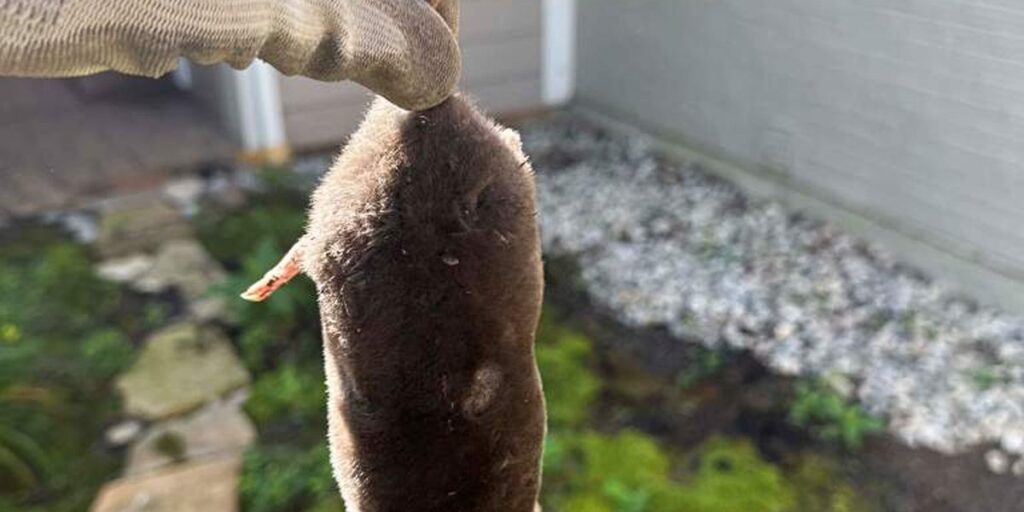
"I recently hired the mole hunter for mole trapping. I have spent countless money and time on traps, product, watching you tube videos trying to learn their behavior and what works best etc… while they continued to QUICKLY take over our lawn and flower beds. THE MOLE HUNTER was recommended by my yard service company and they were extremely responsive to my call. Jeff came out the next day, explained process to my husband and I, looked at our yard, set traps, etc… I am thoroughly impressed with the quick response to our need. We have 16 traps and first day caught this one. I suspect many more will be trapped. If you’re struggling with moles and just can’t get ahead of the destruction they are causing, I highly recommend giving The Mole Hunter a call."
Ready to get rid of the mole for good? Schedule a free inspection, and we'll trap the active runs. Or call (513) 613-2289.