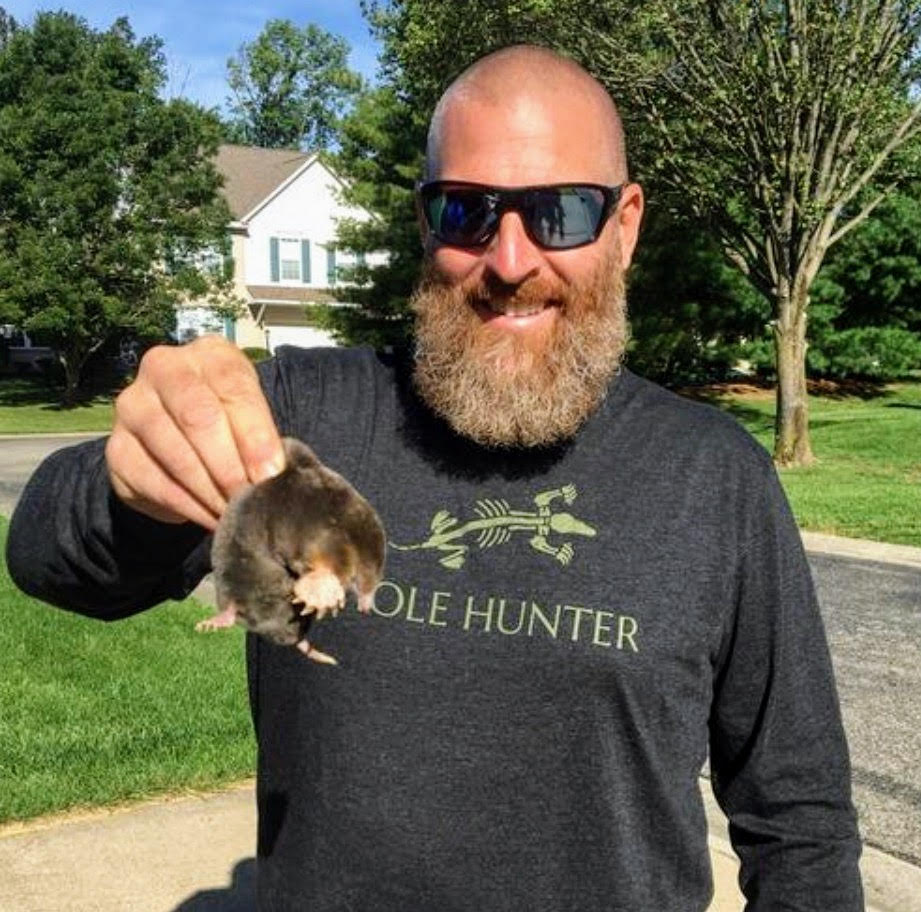
Moles are fascinating underground mammals. Shovel-shaped front paws, blood that carries double the hemoglobin of surface animals, velvety fur that moves in any direction so they can reverse through tunnels without resistance.
But when you walk outside on a Tuesday morning, and your lawn looks like someone drove a dirt bike through it, you’re not impressed. You want them gone.
There are seven mole species in North America, and which one is tearing up your grass depends almost entirely on where you live. East of the Mississippi, it’s one suspect nearly every time. In the Pacific Northwest, it’s a different animal — literally. As local trapping professionals who pull moles out of yards across Cincinnati and Loveland every week, here’s our full breakdown of all seven US species, what each one does to a lawn, and exactly which one is digging up yours.
The 7 Mole Species of North America at a Glance
| Species | Size | Range | Lawn Threat (in its range) |
|---|---|---|---|
| Eastern Mole | 6–8 in. | Eastern US, Midwest | Very High |
| Townsend’s Mole | Up to 9 in. | Pacific Northwest | Very High |
| Broad-Footed Mole | 6–7 in. | California, S. Oregon | High |
| Coast Mole | 6–7 in. | Pacific Northwest | Moderate |
| Hairy-Tailed Mole | ~6.2 in. | Northeast US, Appalachia | Low–Moderate |
| Star-Nosed Mole | 6–8 in. | Northeast US, SE Canada | Low |
| American Shrew Mole | 4–5 in. | Pacific Northwest | Minimal |
Quick rule of thumb: if you’re east of the Rockies, you’re almost certainly dealing with the Eastern Mole. If you’re in Washington, Oregon, or Northern California, it’s Townsend’s or the Coast Mole. California yards belong to the Broad-Footed Mole.
Interactive Mole Species Map
Select a mole species from the buttons below to highlight the states where that species is found.
The map will update automatically so you can see the distribution across the U.S.
Eastern Mole (Scalopus aquaticus)

The most widely distributed mole species on the continent and the top source of lawn mole removal calls across the eastern half of the country, from the Midwest down through Texas and across the entire Southeast. Key physical characteristics include a naked pointed snout, eyes so small and hidden they’re easy to mistake for absent entirely, no visible external ears, and outward-turned forefeet with webbed toes that work like underground shovels.
Those raised, spongy ridges snaking across your grass are shallow feeding tunnels where the mole “swims” through loose soil hunting earthworms, beetle larvae, and insect larvae two to four inches below the surface. The volcano-shaped mole mounds come from deeper permanent tunnels dug eight to eighteen inches down.
A single five-ounce mole eats 70% to 100% of its body weight in worms and soil-dwelling insects every single day. One mole can dig up to 150 feet of new shallow feeding tunnels in a day and travel through existing mole runs at 80 feet per minute. A single animal can make a yard look like ten are working it.
Eastern Moles don’t hibernate. They stay active year-round, adjusting depth to follow earthworms through the seasons. When surface damage slows in winter or drought, the moles have simply dropped below the visible line.
Breeding season runs late winter through early spring. Males tunnel aggressively searching for a receptive female mole. According to the Indiana Department of Natural Resources, after an approximate 44-day gestation period, a litter of three to five young moles arrives. By fall, those young moles excavate their own networks.
Townsend’s Mole (Scapanus townsendii)

The largest mole species in North America at up to nine inches, with dark velvety fur and a nearly hairless tail. It thrives in the deep loamy soils of river floodplains from British Columbia through northwestern California — and it is the Pacific Northwest’s answer to the Eastern Mole.
If you have a mole problem in Seattle, Portland, or the Willamette Valley, this is your prime suspect. Townsend’s Moles build large, conspicuous mounds — often bigger and more numerous than anything an Eastern Mole produces — and a single animal can throw up dozens of mounds across a lawn in a matter of weeks. They’re a serious pest of lawns, pastures, golf courses, and bulb farms throughout their range. Entirely absent from Ohio and the eastern US.
Broad-Footed Mole (Scapanus latimanus)
California’s resident lawn destroyer. The Broad-Footed Mole has exceptionally wide front paws and strong hind feet built for working the rocky, drier soils common across California and southern Oregon. In irrigated lawns and gardens — where watering keeps earthworms close to the surface — this species produces the classic combination of surface ridges and dirt mounds that California homeowners know too well. If you’re dealing with mole damage anywhere from Sacramento to San Diego, this is almost certainly your animal.
Coast Mole (Scapanus orarius)
The Coast Mole shares much of Townsend’s Pacific Northwest range but prefers drier, sandier, better-drained soils. It’s smaller, its mounds are smaller, and the two species are often confused — homeowners in Washington and Oregon may have either one (or both) working the same neighborhood. Damage is real but typically less dramatic than what Townsend’s Mole produces.
Hairy-Tailed Mole (Parascalops breweri)
This species ranges across New England and extends south through the Appalachian Mountains into parts of the Ohio Valley. It’s distinguished by a short, thick tail covered in coarse dark hairs and dense mole fur with a purplish-brown sheen. It prefers sandy loam soils and avoids heavy clay soils. It builds deeper permanent tunnels rather than sprawling surface runways, so while it can produce mounds in northeastern lawns, it rarely causes significant mole-related damage in Midwest suburbs.
Star-Nosed Mole (Condylura cristata)
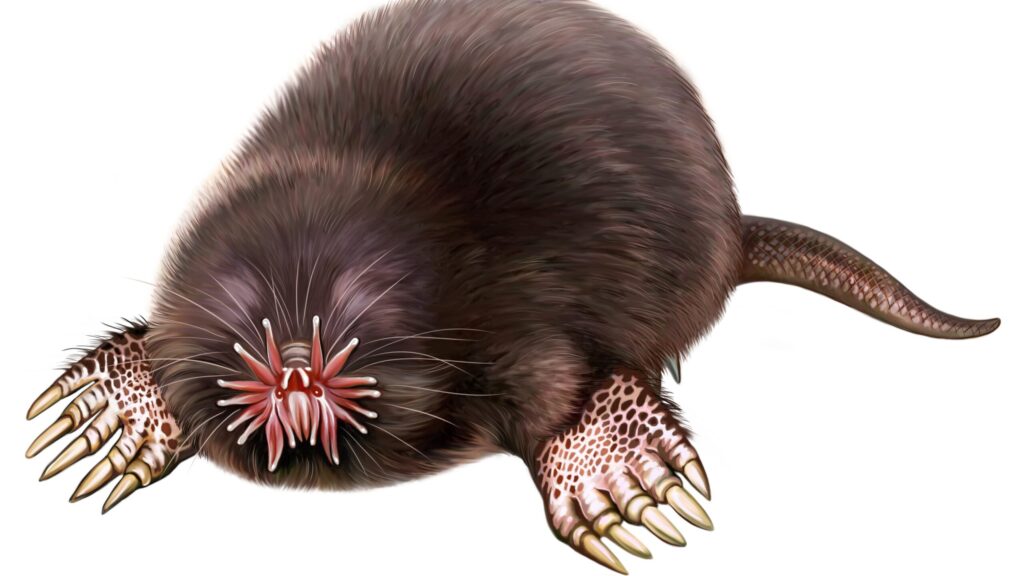
Star-nosed moles live in wet, poorly drained soils near bogs, swamps, and marshes across the Northeastern United States and southeastern Canada. The 22 fleshy pink tentacles surrounding its snout are touch organs covered in over 25,000 sensory receptors, making it the most sensitive touch organ of any known mammal.
This sensory power lets it identify and eat prey in about 200 milliseconds, the fastest-eating mammal ever recorded. It also hunts underwater by blowing and re-inhaling air bubbles to detect scent trails while submerged. Unless your lawn borders a wetland in the Northeast, you’ll likely never see its work — and you won’t find them on Ohio lawns.
American Shrew Mole (Neurotrichus gibbsii)
The smallest mole in North America at just four to five inches, found in the Pacific Northwest. It frequently forages above ground rather than staying in a life underground, doesn’t build the deep tunnel systems of its larger cousins, and is rarely responsible for meaningful lawn damage anywhere.
Ground Moles in Cincinnati and Southwestern Ohio: Which Species Is Destroying Your Yard?
If you live anywhere in the Greater Cincinnati area — whether that’s Loveland, Hyde Park, Batavia, or Finneytown — your problem is almost certainly the Eastern Mole. This common mole accounts for roughly 99% of all residential mole damage in our region.
Why here? It comes down to dirt.
Southwestern Ohio sits on “Cincinnati Silt Loam,” a glacial soil type with deep, crumbly topsoil loaded with organic matter. That soil is paradise for earthworms. And earthworms are what this species primarily feeds on.
There’s also a layer of dense, compacted soil called a “fragipan” that makes the mole problem worse. When spring rains hit the Ohio Valley, this layer traps water high in the soil profile. Earthworms get pushed toward the moist soil near the surface, and the moles follow them right into your lawn’s root zone.
Ohio is technically home to two species — the Eastern Mole and, in limited Appalachian foothill areas, the Hairy-Tailed Mole — but here in Cincinnati we spend 99% of our time pulling Eastern Moles out of lawns.
The Truth About Mole Repellents and DIY Fixes
There is a massive amount of bad advice on this topic, so we’ll be blunt. These facts hold true whether you’re fighting an Eastern Mole in Ohio or a Townsend’s Mole in Oregon.
Killing grubs won’t get rid of moles. Moles primarily feed on earthworms, not grubs. As Purdue University’s turf program confirms, even in grub-free lawns, mole populations persist because the majority of their diet consists of earthworms. If you strip the grubs from your soil, the mole just tunnels more aggressively searching for the earthworms that remain.
Mothballs are illegal to use this way. Fumes vanish almost instantly in a ventilated tunnel network. A mole simply walls off that section and digs around it, creating more mole damage. The EPA considers this off-label use of a registered pesticide.
Sonic spikes don’t work. These small mammals live next to highways and heavy farm equipment. They adapt to repetitive noise within days.
Castor oil-based repellents don’t last. They’re heavily marketed, but any effect is temporary. The oil degrades in the soil and washes away with rain. It’s not a mole control solution.
Toxic baits and poisons don’t provide reliable long-term results against active mole tunnels either, and they introduce severe secondary poisoning risks to local predators and pets. Trapping works. Repellents don’t.
Moles Versus Voles: Don’t Confuse the Two
Before you set any trap, make sure you’ve identified the right pest. We’ve written a full breakdown of moles versus voles for the deep comparison, but here’s the short version.
Moles are insectivores eating insects, earthworms, and grubs. In fact, if you’ve ever wondered is a mole a rodent, the short answer is no. A mole belongs to a completely different order than mice, rats, and voles, which is exactly why rodent-focused baits and traps never touch it. They have paddle-like front feet, tiny concealed eyes, and pointed snouts. Their damage shows up as raised spongy ridges, surface tunnels, and sealed volcano-shaped dirt mounds.
Voles are herbivorous rodents that eat grass roots, plant roots, and flower bulbs. Their damage appears as pathways of dead, chewed grass with small open entrance holes. Setting mole traps for a vole problem or putting out peanut butter bait for a mole infestation is guaranteed to fail. We’ve written a full breakdown of moles versus voles for the deep comparison, but here’s the short version
The Only Proven Way to Stop Yard Damage
Every major university extension program agrees. Mechanical trapping is the only method with proven, long-term results for eliminating mole populations — and that’s true for every species on this list, coast to coast.
It requires targeting the straight, deep travel tunnels that run parallel to sidewalks, driveways, and fence lines, not the meandering shallow feeding tunnels that moles rarely reuse. A professional confirms an active tunnel by pressing down on a section with a boot heel. If the mole pushes dirt back up within 24 hours, the run is live.
In natural settings, moles play a beneficial ecological role through soil aeration and pest control. But on residential lawns, golf courses, and commercial properties, the damage far outweighs any benefit.
If you’re out West, you might be dealing with a Townsend’s or Broad-Footed Mole. But if you’re here in the Greater Cincinnati area with an Eastern Mole problem, skip the DIY cycle and start with professional lawn mole removal. Humane mole control through professional mole control services is the only thing that permanently solves it.
Book your free property inspection and let The Mole Hunter handle it permanently.
Frequently Asked Questions
How many species of moles live in the United States?
There are seven species of North American moles: the Eastern Mole, Star-Nosed Mole, Hairy-Tailed Mole, Townsend’s Mole, Coast Mole, Broad-Footed Mole, and American Shrew Mole. Geography tells you which one you’re fighting. East of the Rocky Mountains, the Eastern Mole causes nearly all residential damage — including here in Ohio, where the Hairy-Tailed Mole also appears in limited Appalachian foothill areas. West of the Rocky Mountains, Townsend’s Mole dominates the Pacific Northwest, the Coast Mole prefers the drier, sandy soils of the same region, and the Broad-Footed Mole handles California.
What do moles feed on?
Moles feed almost entirely on earthworms, with beetle larvae and other soil insects making up the rest. A mole’s diet amounts to 70% to 100% of its body weight in food every single day, which is why one animal can tunnel so relentlessly through a lawn. This is also why killing grubs fails as a control strategy — strip the grubs and the mole simply digs harder for the earthworms that remain.
Why is mole activity worse in spring?
Heavy spring rains push earthworm populations toward the surface, and moles follow their primary food source into your lawn’s shallow root zone. Late winter through early spring is also breeding season, when males expand their territory dramatically, increasing new tunnel construction. Mole activity never truly stops, though. Moles don’t hibernate, they just drop deeper in winter and drought.
What mole control methods actually work?
Trapping moles in their active deep travel tunnels is the only method backed by university research. Mole baits and mole fumigants deliver inconsistent results because moles wall off treated tunnel sections and dig around them, and baits carry secondary poisoning risks for pets and predators. Underground barriers can protect a small garden bed but are impractical for an entire lawn. Repellents, sonic spikes, and grub killers fail outright. Professional mole removal is the only permanent fix — a qualified mole removal service targets the active deep runs that DIY attempts consistently miss.